


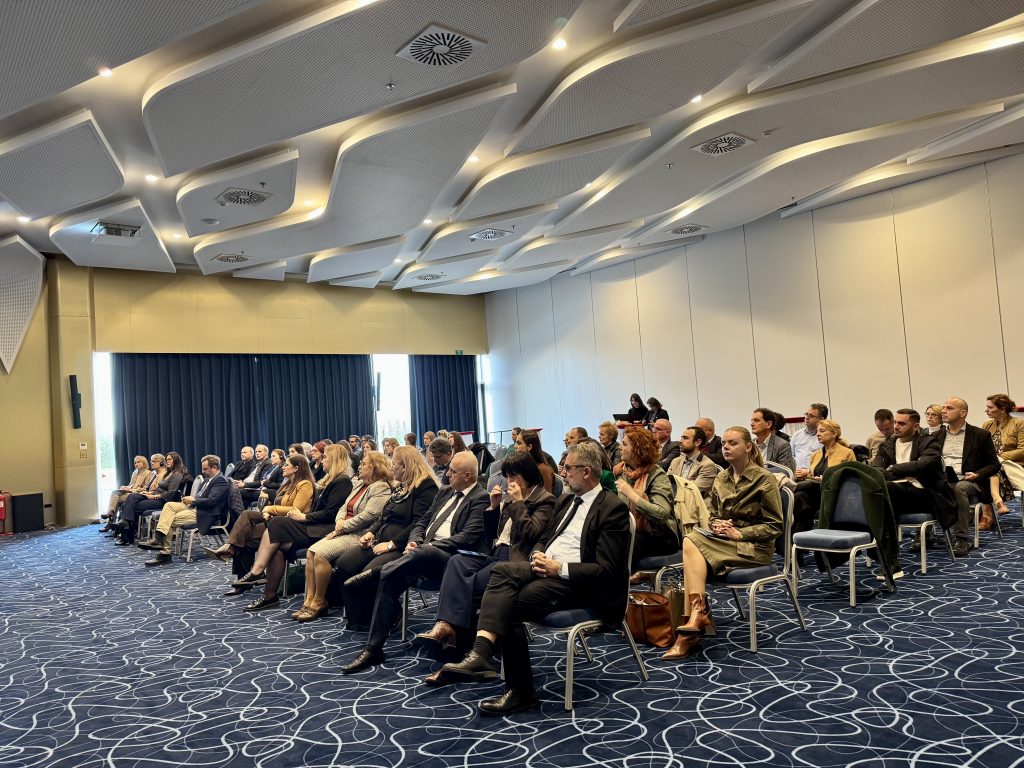
Representatives from healthcare institutions, academia, and public health experts gathered on November 4, 2025, to share insights and research developments from the Kosovo Non-Communicable Disease Cohort Study (KOSCO).
Implemented through the Accessible Quality Healthcare (AQH) Project, in cooperation with the National Institute of Public Health of Kosovo (NIPHK), the University of Prishtina, and the Ministry of Health, KOSCO represents a milestone in strengthening research and building sustainable, evidence-based approaches to prevent and manage non-communicable diseases (NCDs) in Kosovo.
The event opened with remarks from the Ministry of Health, the National Institute of Public Health of Kosovo, and the University of Prishtina, highlighting the importance of long-term research to address the growing burden of chronic diseases, noting that the KOSCO study provides essential data to guide national policies and strengthen the country’s response to non-communicable diseases.
KOSCO has been made possible through the continuous support of the Swiss Agency for Development and Cooperation (SDC). In her address, Merita Stavileci, Senior Programme Officer at the Swiss Embassy, highlighted the study’s significance, noting that “KOSCO has become an important source for understanding the burden of non-communicable diseases in Kosovo. Each of these steps, from institutional finance, academic involvement, and expansion to new municipalities, to continuous scientific publications on these data, brings us closer to establishing a sustainable, nationally led cohort study.” She also emphasized that, like many countries, Kosovo faces a high and rising burden of chronic diseases, while national data on their prevalence, risk factors, and effectiveness of interventions remain limited. For this reason, she noted, SDC responded positively in 2019 to the proposal of the Swiss Tropical and Public Health Institute (Swiss TPH) to initiate this important study.
The meeting continued with the National Institute of Public Health of Kosovo presenting the “Report on Non-Communicable Diseases in Kosovo,” introduced by Prof. Asst. Sanije Hoxha.
Prof. Asoc. Dr. Naim Jerliu from the University of Prishtina and NIPHK emphasized that “this cooperation has strengthened not only research capacities but also the reliability of local research.” He added that KOSCO has directly contributed to key policy frameworks such as the National Plan for Non-Communicable Diseases 2023–2025 and the Action Plan for Primary Health Care 2024–2026. He further underlined that “KOSCO data represent a rare national treasure for analyzing the health trajectory of our population, from lifestyle behaviors and social and environmental factors to changes in clinical indicators over time.” Noting that the study should be structural and sustainable part of national research and public health infrastructure.
The event also featured presentations from Prof. Nicole Probst-Hensch of the Swiss Tropical and Public Health Institute (Swiss TPH), who discussed the links between mental health and chronic diseases such as hypertension and diabetes, highlighting associations between mental health and preventive health indicators.
Dr. Ariana Bytyci Katanolli from AQH/NIPHK presented “KOSCO Through the Years,” summarizing the study’s evolution, milestones, and contributions to strengthening research in Kosovo.
Further, the supervisors from University of Prishtina presented the PhD and master’s thesis concepts developed through and utilizing KOSCO data. Prof. Asoc. Dr. Valbona Beqaj Zhjeqi from NIPHK and the University of Prishtina presented the PhD thesis concept on the effects of motivational counseling in patients with hypertension. Prof. Asst. Dr. Ardita Byci Jakupi from the University of Prishtina discussed the use of KOSCO data to examine the relationship between urban planning and healthy aging, while Prof. Asst. Dr. Aida Loshaj Shala from the University of Prishtina presented the integration of the pharmacovigilance into KOSCO, analyzing correlations between medication side effects and multi-drug interactions.
As the first and only long-term cohort study on non-communicable diseases in Kosovo, KOSCO continues to play a vital role in shaping national health policies, strengthening academic research, and informing effective prevention strategies. Having such a cohort study is essential for understanding long-term health patterns and guiding evidence-based decision-making, marking an important step toward establishing a sustainable, nationally owned research infrastructure that will serve generations to come.