

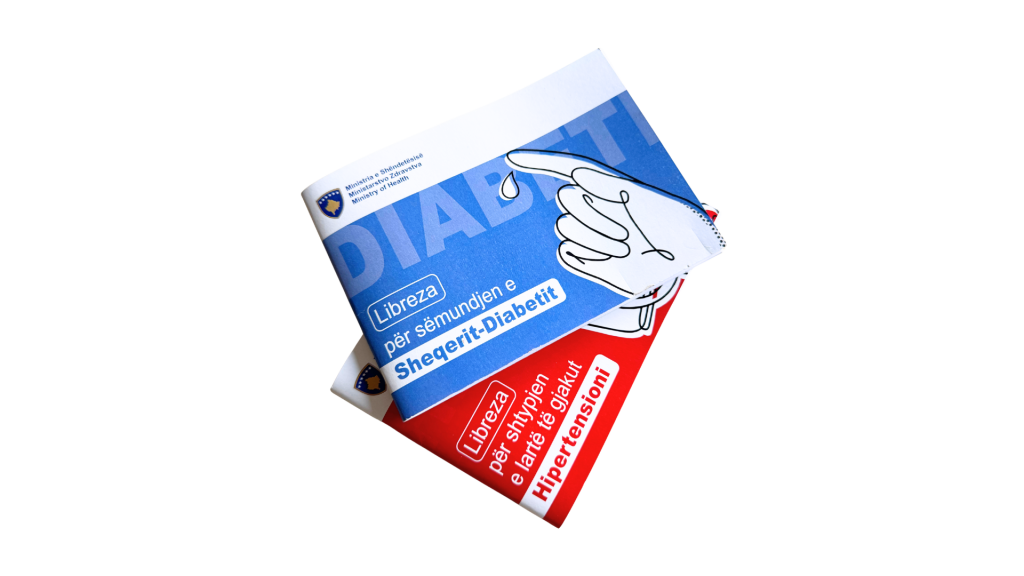
When 86-year-old Emin Gashi talks about his journey with diabetes and hypertension, he pauses and taps gently on the pages of his patient passport, a small booklet used in Kosovo to track blood pressure, glucose levels, medications, and check-ups for chronic diseases. “They are good…as they help us track the condition. I’m fine now, but if I had it under control earlier, it would have been better.”
For Emin, the passport is more than paper. It is a tool that helps him understand his own health. Together with him, the nurses at the Health Education and Promotion Room (HEPR) also update it during check-ups, and doctors rely on it to monitor progress, make informed decisions, and provide more consistent care. Beyond that, these booklets/passports encourage patients to measure, record, and follow up on their own, making them take a stronger role in managing their condition and improving their health literacy.
At the Main Family Medicine Center in Lipjan, nurse Luljeta Recica explains how passports/booklets have changed the way patients and providers communicate. “Patient conditions are tracked. When they fill them out, patients take new ones from the HEPRs as they need them to track, and compare how the condition is presenting”
Patient passports for hypertension, type 2 diabetes, and asthma were first introduced in Kosovo by the Accessible Quality Healthcare (AQH) Project, funded by the Swiss Agency for Development and Cooperation and implemented by the Swiss Tropical and Public Health Institute. Starting in 2018 as a pilot in five municipalities, the initiative expanded gradually. By 2024, the passports were being used nationwide, laying the groundwork for full institutionalization by the Ministry of Health.
In May 2025, the Ministry of Health approved and standardized the national booklets for diabetes and hypertension for primary and secondary healthcare, followed by their rollout across Kosovo. With technical support from the AQH and IHS Project. Their aim is to strengthen the prevention, improve self-management of NCDs, and support health workers with consistent, evidence-based guidance.
“Institutionalizing NCD booklets/passports is a practical, evidence-based strategy that empowers patients, standardizes education, and contributes to more effective prevention and management of chronic diseases,” says Niman Bardhi, Director of the Department for Strategic Health Planning at the Ministry of Health. “When combined with staff training, digital support, and outcome monitoring, it can significantly improve health outcomes and reduce long-term costs to the health system.”
Standardized passports give patients information on the condition, help them track key parameters related to their condition, such as blood pressure for hypertension or glucose levels for diabetes, track weight and medications, and plan routine check-ups by indicating when each clinical examination should be performed. They create a bridge between nurses, doctors, and patients, strengthening continuity of care, referrals, and shared decision-making. And when integrated into digital systems, they can generate valuable data for planning, resource allocation, and monitoring progress at the national level.
“Implementing Diabetes and Hypertension Passports in Primary Health Care strengthens the management of non-communicable diseases (NCDs) by improving continuity, quality, and efficiency of care. They empower patients to take an active role in self-management, promote adherence to treatment, and enhance health literacy. For providers, the passports ensure standardized monitoring, facilitate early detection of complications, and improve communication across health workers and facilities. Overall, they support better disease control, reduce preventable complications, and contribute to more integrated, patient-centered NCD care at the PHC level,” adds Genc Ymerhalili, Senior Health Specialist, AQH Project.
As the AQH Project enters its third and final phase, seeing its interventions adopted and sustained by national institutions reflects its lasting contribution to strengthening Kosovo’s health system, and making the country a healthier place.